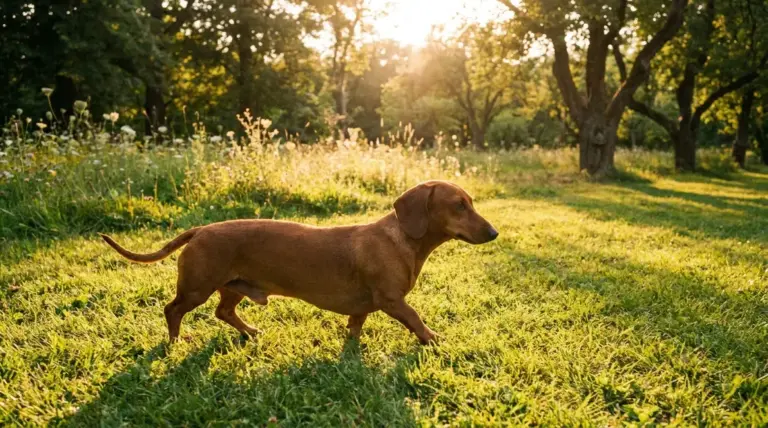
You watch your Dachshund tear across the garden, ears flat, belly low, and you wonder how that compares to a real racing dog. It is a fair question. Short legs and a long body do not look built for speed, yet the sprint is startling the first time you see it.
The trouble is that speed claims online conflict. Most pages quote one number, in one unit, and never say whether it is a short sprint or a pace your dog can hold. That gap is what this guide fills. It treats sprint speed (a top burst over a short distance) and sustained pace (what a dog keeps up over minutes) as two separate questions.
This guide is for owners with some breed familiarity who want a quick, trustworthy answer. It covers top speed, whether size and coat matter, how race benchmarks like sprints, a mile and Fast CAT work, and how far you can safely run with your dog while protecting its spine. It leaves coat colours and buying advice to other pages, such as our complete short-haired dachshund owner guide.
- A Dachshund’s top speed is a short-burst figure, not a pace to hold, so judge any number by its distance.
- Short legs do not rule out fast sprinting; the breed’s hunting purpose explains why.
- Size and coat are less useful predictors than your own dog’s fitness, and no verified figures separate miniatures from standards.
- Reader reports of long fast runs exist, but they are individual experiences, not safe standards.
- Build up slowly, run on forgiving surfaces and stop at any sign of back pain or stiffness, then call your vet.
Table of Contents
- Key Concepts & Terminology
- How Fast Can a Dachshund Run in mph and km/h?
- Does a Miniature Dachshund Run Slower Than a Standard?
- Dachshund Race Times: Sprints, a Mile and Fast CAT
- Can Dachshunds Run Long Distances Safely?
- When Running With Your Dachshund Is the Wrong Call
- Next Steps
- FAQ
Key Concepts & Terminology
Five terms explain most of the confusion in forum threads about Dachshund speed. Here they are in plain language.
- Sprint speed: the fastest a dog moves over a short burst, usually a few seconds to a short straight run.
- Sustained pace: the speed a dog can keep up for minutes or miles. It is always lower than sprint speed.
- Fast CAT: a timed sprint event where a dog chases a lure along a straight track. It measures a short burst, not endurance.
- Trot versus gallop: a trot is a steady, two-beat gait that dogs can hold for a long time. A gallop is the stretched, bounding gait used for bursts of top speed.
- IVDD (intervertebral disc disease): a condition where the cushioning discs between spine bones bulge or burst, pressing on the spinal cord. Long-backed breeds like the Dachshund are known for it.
Most conflicting speed claims come from mixing these up. A figure for a gallop over a few seconds gets repeated as if it were an everyday pace, and the two are very different things. Keep that split in mind as you read the numbers that follow.
How Fast Can a Dachshund Run in mph and km/h?
A Dachshund is fast in short bursts, but this guide cannot give you a verified mph or km/h top speed. No source supplied for this article carries a measured figure, and the numbers floating around online are not reliable enough to repeat.
What you can rely on is how to read any figure you meet. Speeds appear in miles per hour (mph) and kilometres per hour (km/h), and the two units can be converted into each other with a simple multiplication or division. A claim given in one unit should always match its twin in the other, so if the two versions disagree, treat the claim with caution.
Next, ask how it was measured. A figure from a timed straight sprint is a very different thing from a phone’s GPS reading on a walk, or a guess from watching a video. Timed runs over a known distance are the most trustworthy. Casual estimates tend to run high, because a dog moving fast looks faster than it is.
Sources also differ because they measure different dogs, distances and surfaces. A young, fit dog on a flat track will beat an older dog on grass. Treat any single number as a rough ceiling for a good day, not a promise for your own Dachshund.
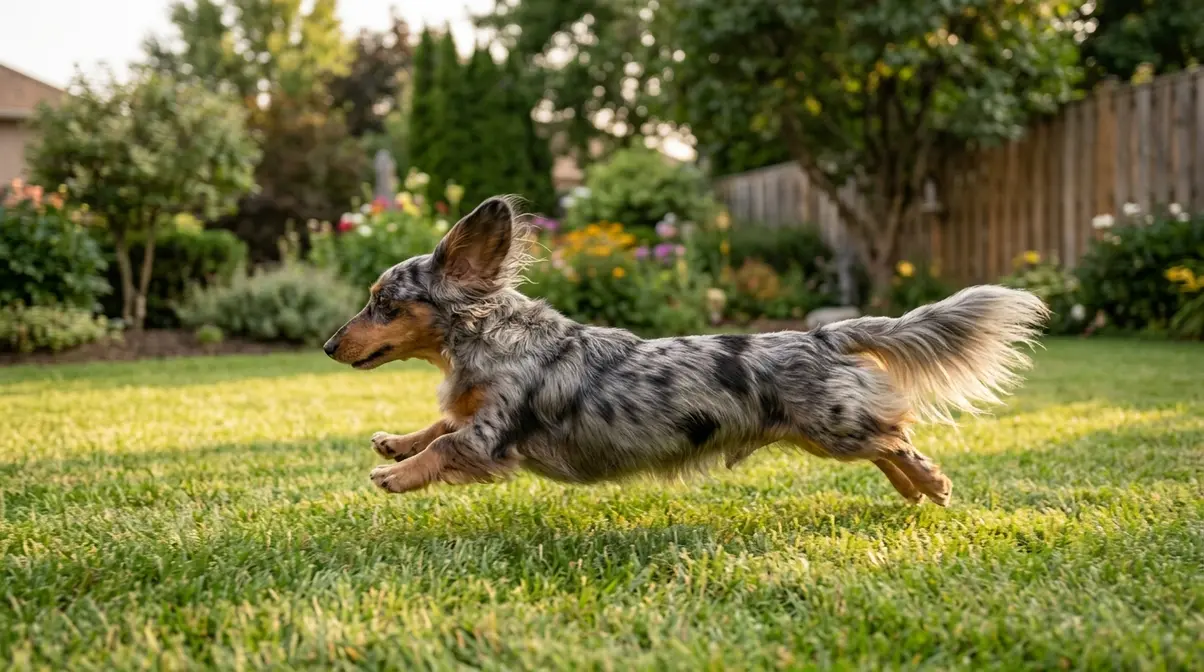
The 100m Dachshund Dash! – Wiener Dog Race!
To see why the speed is possible at all, it helps to know why the breed was built the way it was, which our page on why dachshunds have short legs covers in more depth.
Why Short Legs Still Mean Real Speed
Short legs do not stop a Dachshund sprinting, because speed comes from stride power and body design as much as leg length. Dachshunds were bred as hunting dogs, so the body is built for work, not just for show.
The breed’s job involved going to ground after quarry, and it also meant chasing game above ground. That calls for a strong chest, muscular hindquarters and a drive to keep moving. A short-legged dog covers ground with quick, powerful strides rather than long, loping ones.
Say a friend insists a Dachshund cannot be fast with legs that short. Point to the stride: a dog with quick turnover and strong drive can still look startlingly quick over a short distance. What the breed was built for, though, is not the same as what it is good at today. Short, intense bursts suit it far better than long, flat-out distance. Judgment call: the speed is real, but it is a sprinter’s gift, not a marathoner’s.
Sprint Speed vs Sustained Pace
Top speed is a burst; everyday pace is much lower. A Dachshund that hits its best speed for a few seconds cannot hold that for a whole walk, and you should not expect it to.
In practice, dogs settle into a trot for steady movement and switch to a gallop when they chase something. A trot is efficient and sustainable. A gallop burns energy fast and loads the body harder, which matters for a long-backed breed.
Reader reports show the range of experience, and they are worth reading with care. One reader on Reddit says their Dachshund can keep a 15 to 20 mph run for a couple of miles before wanting a break (source). That is one owner’s account, with no measurement method given, so it is not a rule and not a safe standard for your dog.
A different reader on Reddit describes a more typical picture: at a jogging pace of 3 to 5 km/h, their Dachshunds would probably be trotting rather than galloping, though they say they are not entirely sure. That fits the general pattern, with a trot at everyday paces and a gallop saved for bursts.
Imagine you read that a Dachshund hit a high speed and wonder if yours could do that for a whole walk. The safe assumption is no. Treat the top number as what a good sprint looks like, and plan your runs around a trot. One long fast run reported by one owner says little about what your own dog’s body can take.
Does a Miniature Dachshund Run Slower Than a Standard?
If you own a miniature long-haired Dachshund, expect a quick, sprinty dog, not a slow one. Size probably matters less than you think, and no verified figure compares miniatures with standards.
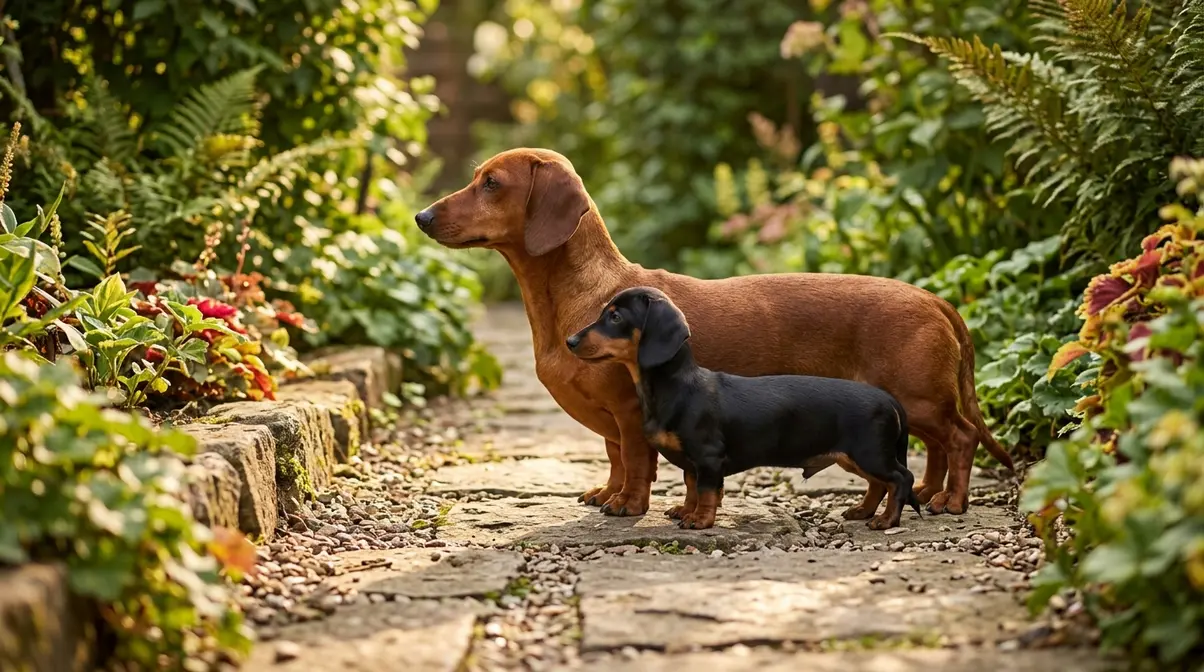
In general terms, a standard is a little larger with a slightly longer stride, while a miniature takes quicker, smaller steps. Neither difference is large enough to make one a clear winner by a margin you could reliably measure on your lawn. A mini long haired Dachshund and a standard Dachshund both bring the same hunting build and the same sprint-first design.
For a miniature, expect bursts that look surprisingly quick for the size, then a clear need to slow down. For a standard, expect a similar pattern with a touch more reach. Because no source supplied here compares the two, any precise gap you read elsewhere should be treated as unverified.
Coat type probably matters even less. A dapple long haired Dachshund and a smooth-coated one share the same underlying build. Coat can affect heat tolerance on a warm day, because a thicker coat holds more warmth, but it does not meaningfully change how fast the dog moves.
Fitness, age and weight matter more than size. A lean, fit miniature will outrun an overweight standard every time. Extra weight also adds load to the spine, which is a safety issue as well as a speed one. For more on coats, see our guide to dachshund coat types and colours.
Dachshund Race Times: 100m, a Mile and Fast CAT
Race benchmarks give useful context, but this guide cannot print verified times. No supplied source carries a sprint time, a mile time or a Fast CAT record for Dachshunds, so none are given here.
What you can use is the structure of each benchmark.
| Benchmark | What it measures | How to read it |
|---|---|---|
| Sprint | A short straight run | Closest to top speed; shows burst ability |
| Mile | Sustained effort over a long distance | A different question; tests pace and stamina, not sprint |
| Fast CAT | A timed lure chase on a straight track | A burst measure, usually run over a short distance |
Fast CAT is a timed sprint where a dog chases a lure. Its record shows a dog’s best burst over that track, not what it can hold. Because the event is timed and controlled, it is a more reliable source than a casual estimate, but you would need the official results to quote a figure.
A mile is a different question from a sprint. A dog that explodes over a short sprint may be far slower per minute across a mile, because pace, heat and recovery all take over. Comparing the two as if they were one speed is exactly the mistake that creates conflicting claims.
Comparisons with humans are common. One reader on Reddit points to the human world-record sprint speed of 37.57 km/h and suggests a dog over a shorter distance could be faster (source). That is a reader’s prompt, not a measured comparison, and no verified figures are supplied here for Dachshunds against other dogs or people. Use benchmarks as comparisons, not as targets for your own dog.
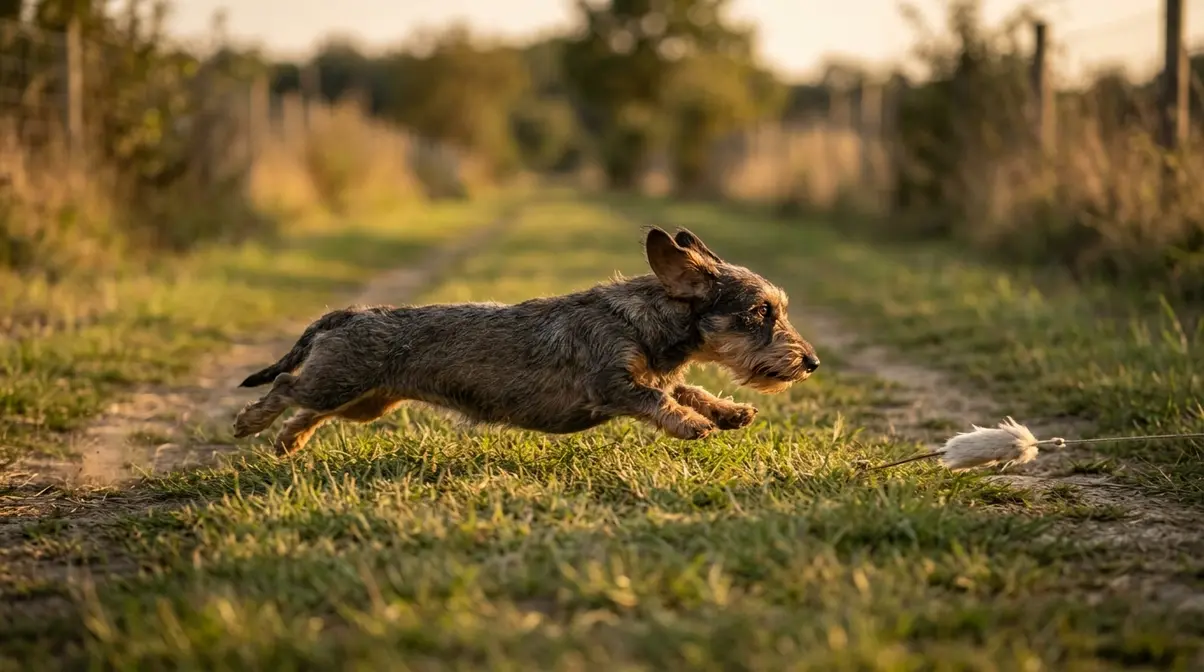
Fastest wiener dog in the West crowned at Wienerschnitzel race
Can Dachshunds Run Long Distances Safely?
Picture yourself lacing up for a first jog with your Dachshund and wondering how far to go. Many fit adult Dachshunds can run with you, but build up slowly and watch the back at every step.
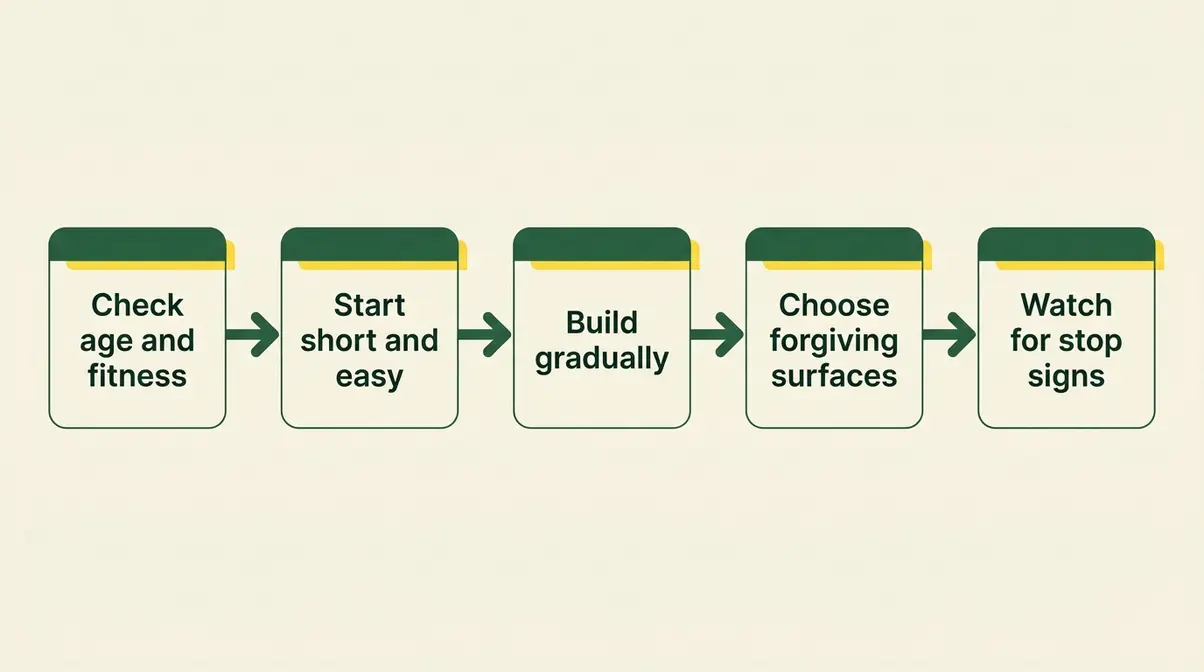
Here is a simple build-up checklist:
- Check age and fitness. Skip hard running for puppies with developing bones and for older or overweight dogs. Ask your vet first if you are unsure.
- Start short and easy. Begin with short jogs at a trot, mixed with walking.
- Build gradually. Add a little time only when your dog finishes each run comfortably.
- Choose forgiving surfaces. Grass and packed trails are kinder than hard pavement, and avoid steep slopes.
- Watch for stop signs. Lagging, panting hard, reluctance to continue, stiffness or yelping mean stop.
A long spine and the risk of IVDD are why limits matter. Repeated hard impact and twisting loads a back that is already prone to trouble. Our page on spine risks in dachshunds explains the health side in more detail.
Owners disagree on this, and the evidence supplied here cannot settle it. One reader on Reddit says their Dachshund ran about 5 km twice a day alongside a bike on a commute, with training, a slow build-up, cues taken from the dog and easy pacing, plus a carrier in case the dog tired (source). Another reader says their dog held a fast run for a couple of miles. Against that, back-health concerns argue for caution, because a fit dog can still injure its spine. These are individual experiences, not safe standards.
If your dog shows pain, weakness, dragging paws or a sudden refusal to move after a run, stop and see your vet promptly.
When Running With Your Dachshund Is the Wrong Call
Skip or shorten a run whenever your dog seems off, because walking is nearly always the safer choice for a long-backed breed. A run should never be pushed through discomfort.
Common pitfalls include:
- Starting too fast, with no warm-up or build-up.
- Running on hard ground such as pavement in the heat.
- Treating speed claims as a training target, as if your dog should match a number from the internet.
- Continuing after the first sign of tiredness.
- Running a puppy, an older dog or an overweight dog hard.
Walking suits better when your dog is young, older, carrying extra weight, recovering from illness or simply having a low-energy day. Steady walks still give real exercise without the same load on the spine.
Imagine your Dachshund seems stiff after a run and you wonder whether to continue. Stop. Rest, watch closely, and do not run again until the stiffness is gone and your vet agrees. Yelping when touched, a hunched back, wobbling, reluctance to climb stairs or any weakness in the back legs are signs to call a licensed vet the same day. This guide cannot diagnose anything, and only your vet can.
Next Steps
You now have the main picture: a Dachshund is quick over short bursts, slower at everyday pace, and best protected by gentle, gradual running.
- Recap the numbers you need. Treat top speed as a burst figure, and always check which distance and unit a claim uses.
- Plan a first easy jog. Keep it short, at a trot, on soft ground, and add time slowly over several weeks.
- Learn the warning signs. Read up on spine health on our spine risks in dachshunds page before you increase distance.
- Pick a coat if you are choosing a dog. Coat does not change speed much, so choose by temperament and care needs. Our blue coat dachshund guide is a good place to start.
Start this weekend with a short, easy outing and let your dog set the pace.
FAQ
Yes, over short distances. A Dachshund’s hunting build gives it real sprint speed, but it cannot hold that pace for long. Think of the speed as a burst for a few seconds, not a pace for a whole walk.
Do Dachshunds need another dog?
Not always. Many Dachshunds do well with plenty of human company, play and routine, while others enjoy a canine friend. It depends on your dog’s temperament and how much time you are home, so watch for signs of boredom or loneliness.