⚠️ Medical Disclaimer: This article is for informational purposes only and does not constitute veterinary advice. If you have concerns about a dog’s health or genetics, consult a licensed veterinarian.
You’ve seen the listing, “rare double dapple dachshund puppies available”, and something made you pause. That instinct is worth following.
“This is my beautiful boy Guppy ❤️ He is a result of an accidental litter, and is a double Merle / double dapple. He’s completely deaf and partially blind. He’s so lovely and otherwise very healthy, but does anyone have any tips on how to navigate with a deaf bab”
, A Dachshund owner on Reddit’s r/Dachshund community
Guppy’s story captures exactly what makes the double dapple conversation so important. These dogs can be wonderful, loving companions, and the health risks are real. In this guide, you’ll learn exactly what a double dapple dachshund is, why the genetics matter, and what to do if you’re considering one.
A double dapple dachshund carries two copies of the merle gene and faces a significantly elevated risk of blindness, deafness, and eye deformities compared to other Dachshunds.
- What it is: A double dapple results from breeding two dapple (merle) parents, each contributing one copy of the PMEL gene.
- The risk: Roughly 25% of puppies from a dapple × dapple pairing may inherit two copies (Dachshund Breed Council), and double merle offspring may be prone to health problems (UC Davis Veterinary Genetics Laboratory), meaning three in four puppies from such a pairing are not double dapples, but the one in four who is faces real consequences.
- The consensus: The Dachshund Breed Council calls mating two dapples irresponsible and unacceptable, and the Royal Kennel Club does not register puppies from merle-to-merle matings.
- The “Double Dapple Risk Ladder”: Not every double dapple is severely affected, outcomes range from fully healthy to profoundly disabled. Understanding where a dog sits on this spectrum is essential before you commit.
- Your best path: If you’re drawn to this dog, rescue is the most ethical route.
What Is a Double Dapple Dachshund?
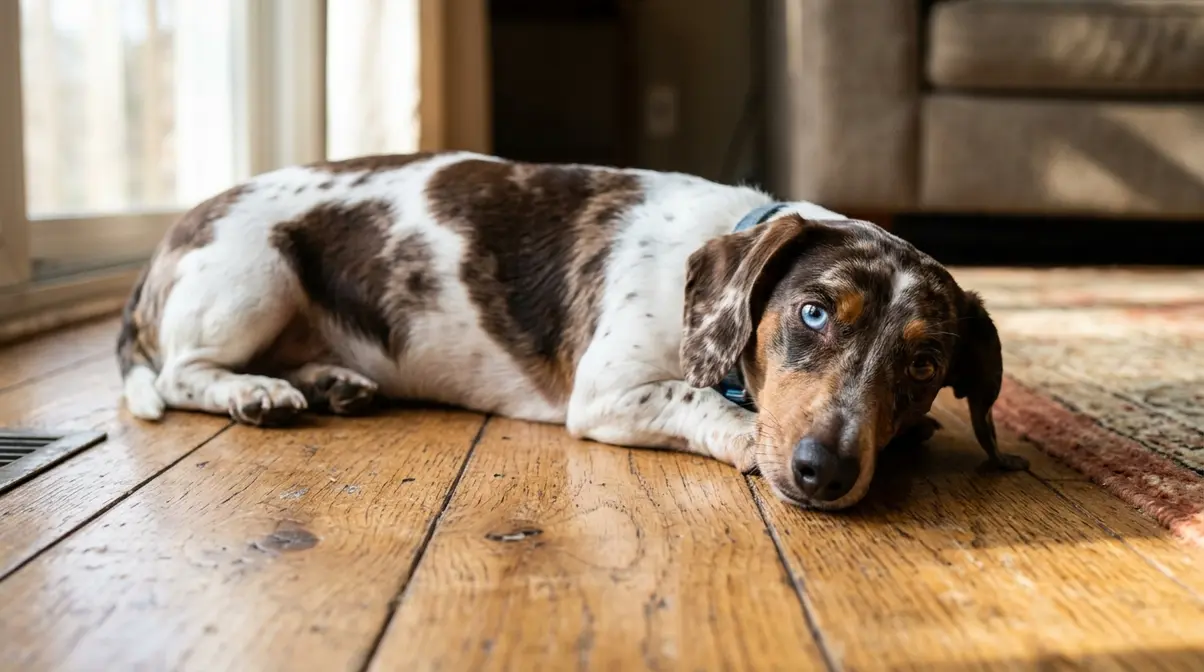
A double dapple Dachshund is a dog that has inherited two copies of the dapple (merle) gene, one from each parent. That double dose of the PMEL gene creates large, irregular white patches on the coat and significantly raises the probability of congenital eye and ear defects. According to how a double dapple is created, a double dapple results when two dapple Dachshunds both contribute their dapple gene to one puppy (Dachshund Magazine On-Line).
“Blindness and/or deafness is also caused by the double dapple gene. On the other hand, a double dapple can be born with no deformities at all.” (Dachshund Magazine On-Line)
This is where The Double Dapple Risk Ladder becomes a useful mental model. Not every double dapple ends up severely affected, outcomes exist on a spectrum with four broad rungs: unaffected single dapple, mildly affected double dapple, moderately affected double dapple, and severely affected double dapple with multiple defects. Where a specific dog lands on that ladder cannot be predicted by appearance alone. Knowing how to spot a double dapple is the first step, but the more important question is what that identification means for the dog’s health.
For a deeper look at the single dapple pattern before comparing, see understanding the dapple coat pattern.
How Can You Tell If a Dachshund Is Double Dapple?
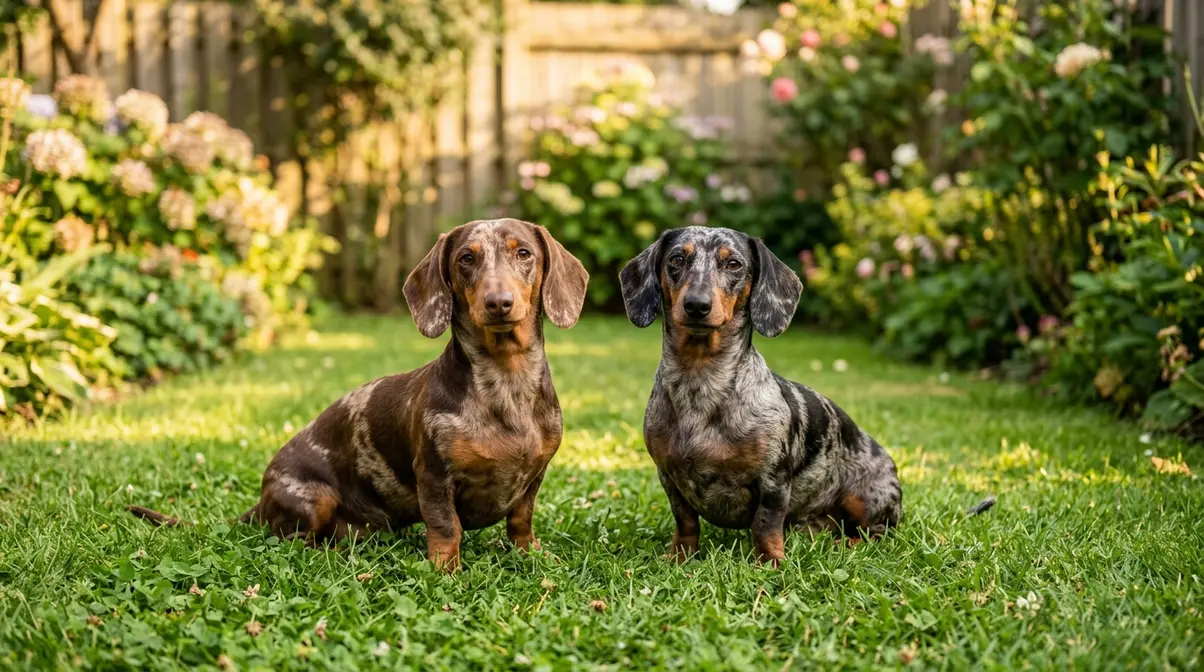
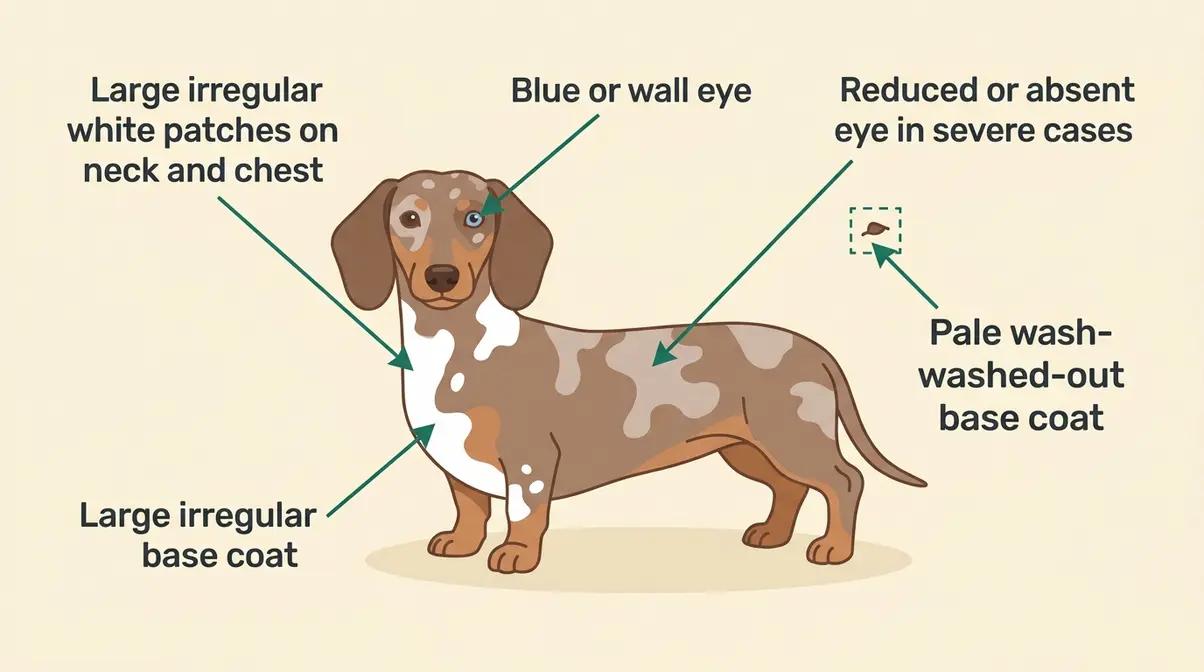
Identifying a double dapple visually is possible, but it’s not foolproof. Large irregular white patches, often around the neck and paws, are a key visual indicator of double dapple status (Dachshund Breed Council). Here are four markers you can check:
- Large, irregular white patches, look for white areas on the neck, chest, paws, and tail tip. These patches are bigger and less uniform than the small dappled spots on a single dapple.
- Blue eyes (one or both), one or two blue eyes suggest elevated pigmentation disruption; a “wall eye” (one blue, one brown) is also common. Blue eyes alone don’t confirm double dapple status, single dapples can also have one blue eye.
- Lighter-than-expected base coat, the overall coat may look washed out or paler than you’d expect for the base color.
- Reduced or absent eyes, in the most severely affected dogs, eyes may appear abnormally small or may not be visible at all.
Visual identification isn’t definitive. Some double dapples carry minimal white and look almost indistinguishable from a single dapple. A PMEL gene test through a veterinary genetics laboratory, such as UC Davis VGL, is the only reliable confirmation.
Once you’ve spotted the visual signs, the next question is what the dog actually looks like across different coat types, and why appearance varies so much.
What Does a Double Dapple Dachshund Look Like?
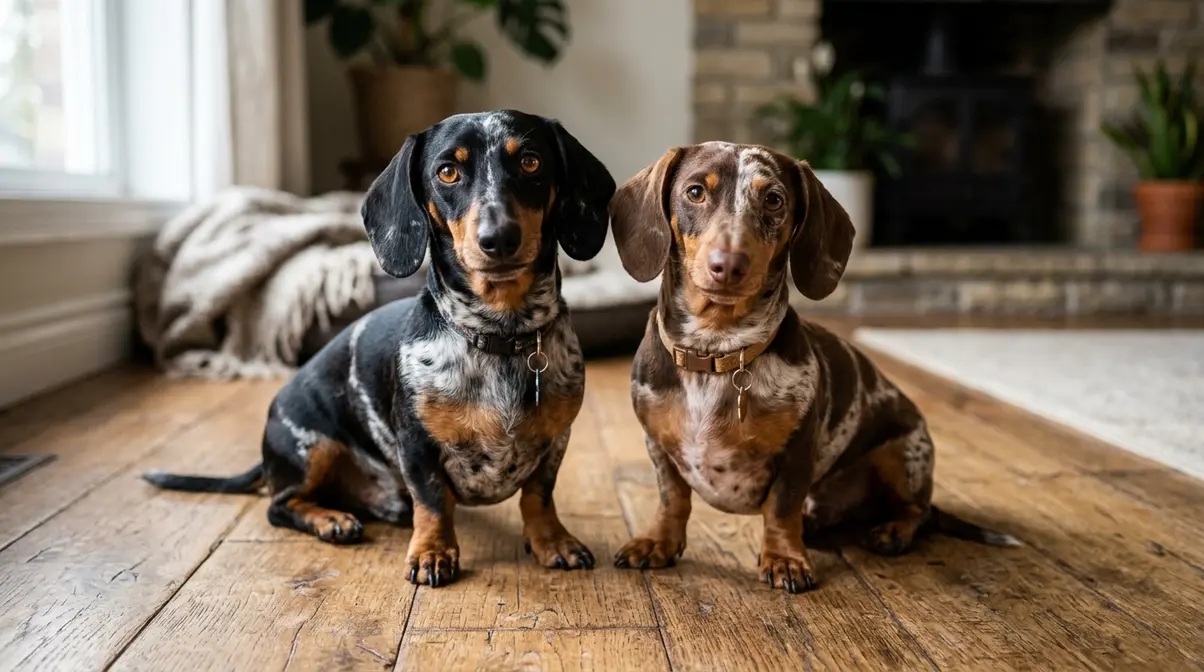
What does a double dapple Dachshund look like? Think “patchwork”, irregular white areas overlaid on a base color (chocolate, black, red, silver) that create a coat appearing almost random compared to the uniform dappling of a single dapple. The white patches don’t follow a predictable shape or location, which is one reason owners find the pattern so striking.
Eye appearance varies considerably. You might see two blue eyes, a “wall eye” (one blue, one brown), or, in severely affected individuals, microphthalmia (eyes that are smaller than normal and may not function fully) or anophthalmia (born without one or both eyes). Blue eyes in double dapples result from reduced pigmentation in the iris, not a separate gene.
The base color changes the overall look dramatically. A chocolate double dapple presents as a warm brown dog with white patches, while a black double dapple shows sharp contrast between the dark base and white areas. The white patching pattern remains consistent across all base colors, even as the overall impression shifts. See the annotated diagram above for a side-by-side comparison of coat patterns.
Knowing what a double dapple looks like is important, but understanding why they look this way, and what it means for their health, requires a closer look at the genetics.
Health Risks and Problems in Double Dapple Dachshunds
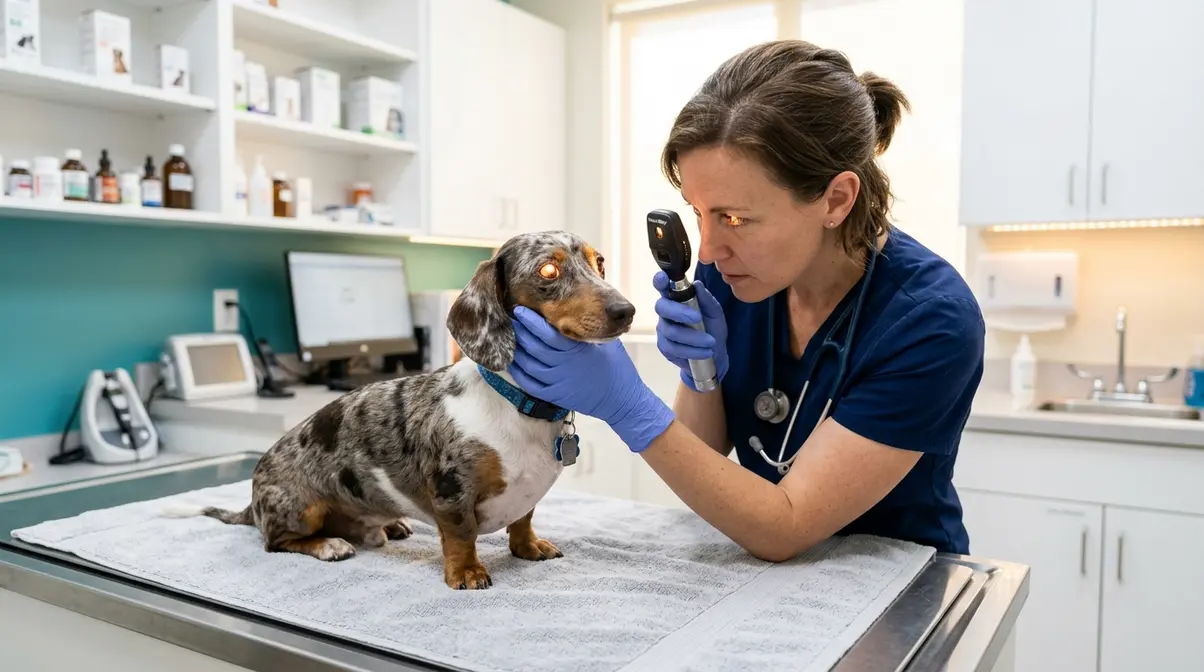
Double dapple Dachshunds face a well-documented set of health risks tied directly to their genetics. According to the Dachshund Club of America (2020), double dapples are more likely to carry health issues such as deafness, reduced eye size, or missing eyes. Dogs with two copies of the merle gene variant also have an increased risk of eye and ear problems (Royal Kennel Club). These risks are real, but they exist on a spectrum. The Double Dapple Risk Ladder reminds us that the 25% of puppies who inherit two merle copies sit at the top of that ladder, carrying the highest probability of severe outcomes.
Guppy, “completely deaf and partially blind” but “otherwise very healthy”, is a real example of a dog at the moderate rung: significantly affected yet capable of a full, joyful life. That nuance matters before you make any decision.
If you’re caring for a double dapple Dachshund with known health issues, work closely with a veterinarian experienced in the breed.
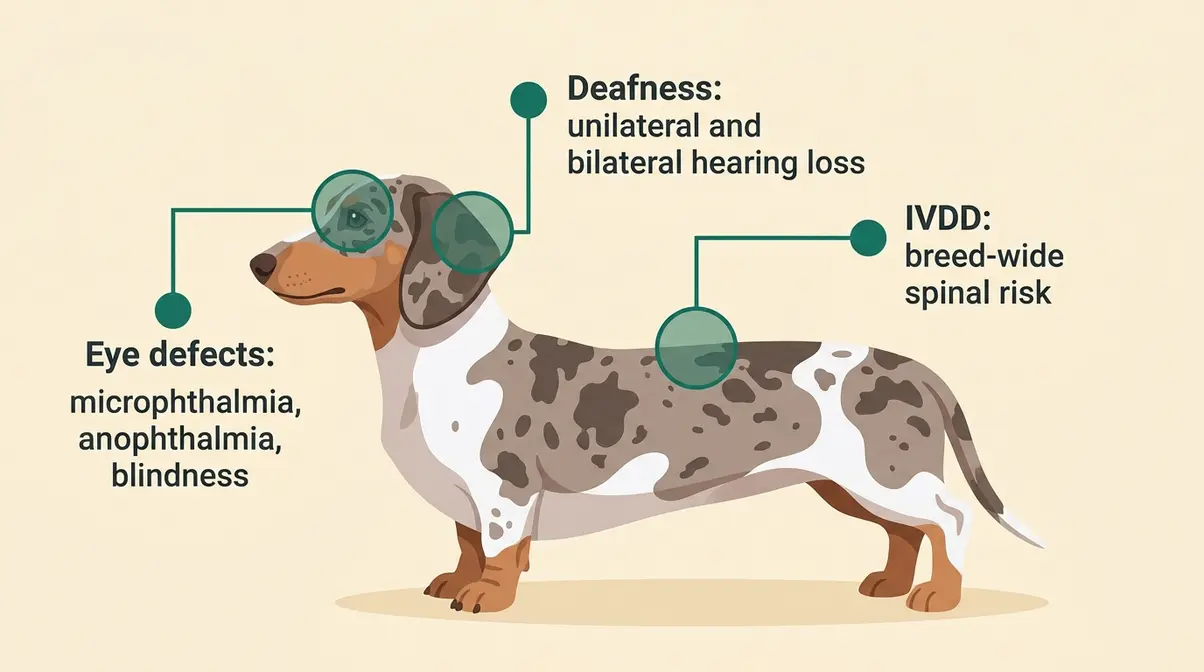
These health risks don’t happen by chance, they’re the direct result of a specific genetic mechanism that every prospective owner should understand.
Eye Problems and Blindness in Double Dapple Dachshunds
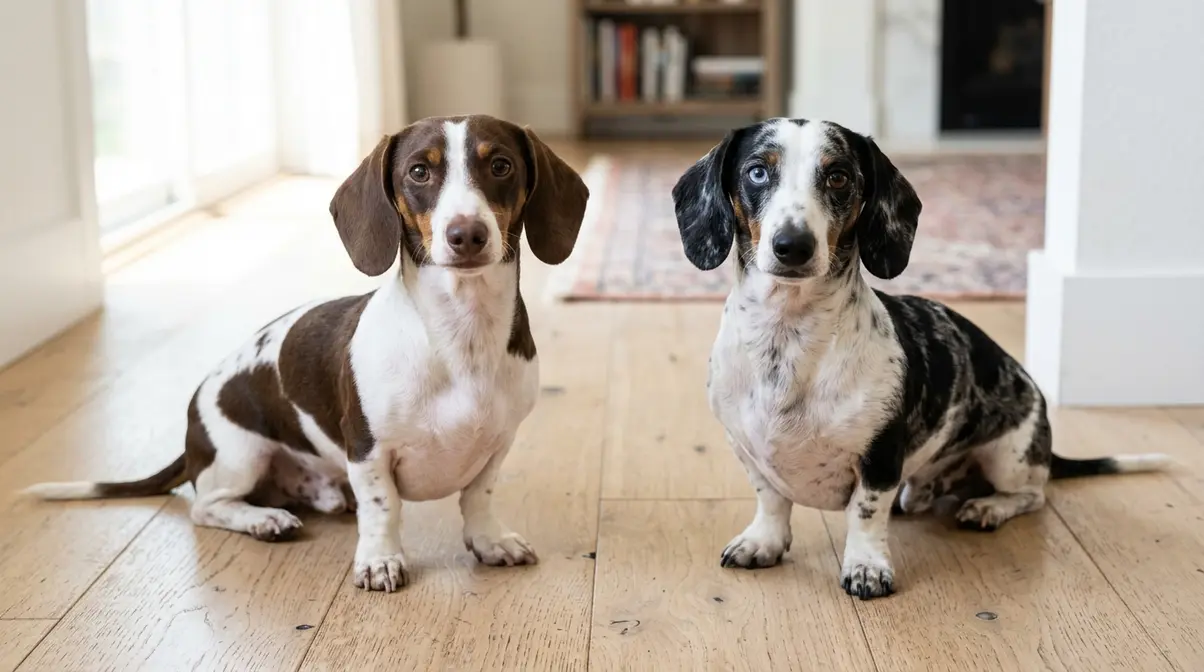
Double dapple Dachshund eye problems range from mild pigmentation changes to complete absence of eyes. The Dachshund Club of America (2020) documents reduced eye size and missing eyes as known health issues in affected dogs. At the severe end of the spectrum, microphthalmia means eyes that are smaller than normal and may not function fully; anophthalmia means born without one or both eyes entirely.
The characteristic double dapple dachshund blue eyes, one or both, result from reduced iris pigmentation, not a structural defect in themselves. It’s the structural eye defects that cause actual impairment, not the blue coloring. Some double dapples have full, functional vision; others are partially or completely blind. The outcome cannot be predicted by appearance alone.
Guppy is “partially blind”, a real-world outcome that still allows a good quality of life with the right care and environmental adaptations. Do not assume the worst for every double dapple, but do not skip the ophthalmological assessment either.
Eye problems are the most visible concern, but hearing loss can be just as significant, and harder to detect in a young puppy.
Deafness and Hearing Loss
The same PMEL gene that creates white patches also disrupts pigment cells in the inner ear, specifically the stria vascularis, a lining of the cochlea. In pigment-associated deafness, the stria vascularis degenerates first, and that degeneration is usually linked to the absence of functioning melanocytes, the pigment cells (Strain, Frontiers in Veterinary Science, 2015). Dogs with two copies of the merle gene variant have an increased risk of eye and ear problems (Royal Kennel Club).
Deafness in double dapples exists on a spectrum. Unilateral deafness (one ear affected) is often missed because the dog compensates naturally, you might not notice until a vet tests formally. Bilateral deafness (both ears affected) is usually apparent early: the puppy doesn’t respond to sounds, startles easily, or sleeps through noise that wakes other dogs. In one hearing study of merle dogs of several breeds, 10% of double merles were deaf in one ear and 15% in both, compared with 2.7% and 0.9% of single merles (Strain et al., Journal of Veterinary Internal Medicine, 2009).
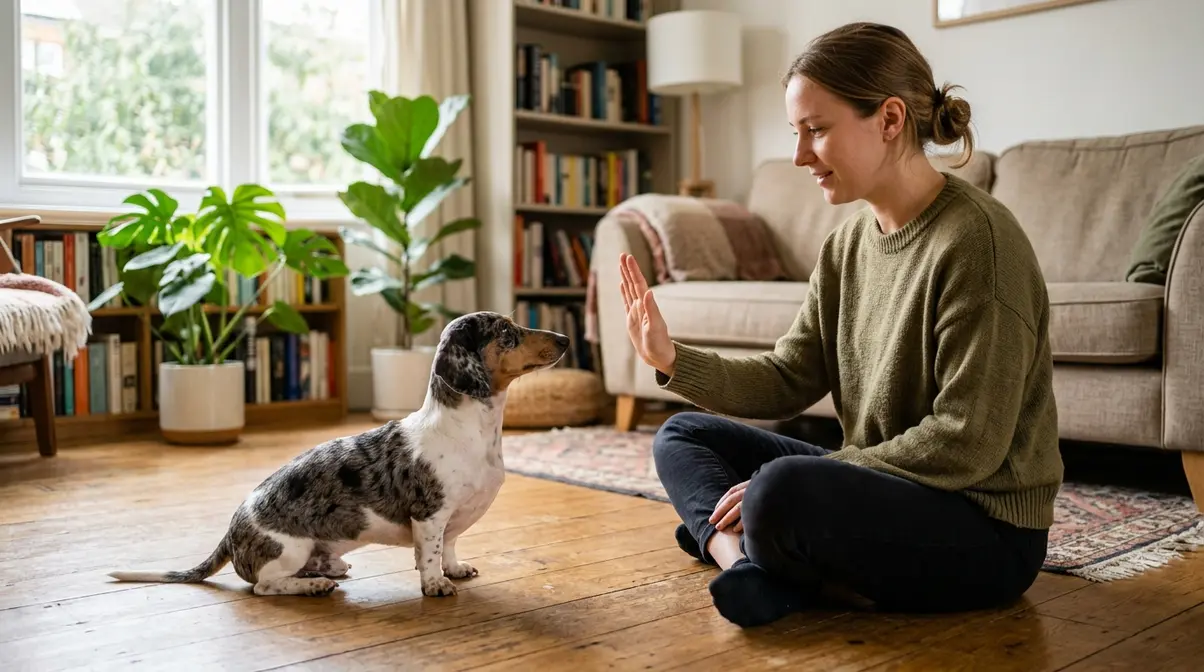
The BAER test (Brainstem Auditory Evoked Response) is the standard veterinary diagnostic for deafness in dogs: it detects electrical activity in the cochlea and the auditory pathways of the brain, and a deaf ear gives an essentially flat line (Louisiana State University School of Veterinary Medicine). If you’re caring for or considering a double dapple, request this test. Many breeders of double dapples don’t test for deafness, which is itself a significant red flag (more on this in the breeders section). Guppy is “completely deaf” and still lives a full, happy life, but his owner needed to adapt. Deaf Dachshunds respond well to hand signals and vibration cues once trained consistently.
Beyond eyes and ears, double dapple Dachshunds share the same health vulnerabilities as the broader breed, with one important caveat about lifespan.
Other Health Conditions and Life Expectancy
IVDD, intervertebral disc disease, a spinal condition common to all Dachshunds due to their long back, is a breed-wide risk, not specific to double dapples. However, a double dapple already managing vision or hearing loss may face compounding challenges if IVDD affects mobility. What do Dachshunds usually die from? Published, breed-specific data on causes of death are limited. IVDD is the breed’s best-documented serious condition: an estimated 19-24% of Dachshunds show clinical signs of IVDD during their lifetime (DachsLife 2015, Royal Veterinary College), and the American College of Veterinary Surgeons estimates that Dachshunds account for 40 to 75% of all IVDD cases (Cornell University College of Veterinary Medicine).
Some reports suggest that certain double dapple Dachshunds may also show susceptibility to kidney issues or a higher risk of renal dysfunction (Rocky Mountain Dachshund Rescue), though peer-reviewed prevalence data on this is limited, qualify this as “some reports suggest” rather than an established finding.
The American Kennel Club gives a life expectancy of 12-16 years for the breed. There is no documented evidence that double dapples have a shorter lifespan than this range. However, quality of life and veterinary costs can be significantly higher, specialist eye and hearing assessments in the first year alone represent a real financial commitment.
The “otherwise very healthy” reality is honest: a double dapple can live a full lifespan with appropriate care, but that care requires commitment. How long do mini Dachshunds live? The same 12-16 year range applies to the miniature size, and a miniature double dapple carries identical genetic health risks.
If you’re considering a double dapple, consult a veterinarian before committing, and budget for specialist eye and hearing assessments in the first year.
The Genetics and Ethics of Double Dapple Breeding

Understanding the Merle Gene: The dapple pattern in Dachshunds is caused by the PMEL gene, the same gene known as “merle” in other breeds. When one copy is present, the dog is a single dapple. When two copies are inherited, the dog is a double dapple.
Many double dapple Dachshunds are the result of an accidental litter, where neither owner knew both parents carried the dapple gene. When two dapple Dachshunds breed, the Punnett square outcomes are straightforward: roughly 25% of puppies will be non-dapple, roughly 50% will be single dapple carriers, and roughly 25% will be double dapples, the same 25% chance per puppy the Dachshund Breed Council gives. That 25% figure, one in four puppies, is where the elevated health risks concentrate. Breeding two dogs that possess any of the merle (dapple) variants may produce health problems in double merle offspring (UC Davis Veterinary Genetics Laboratory).
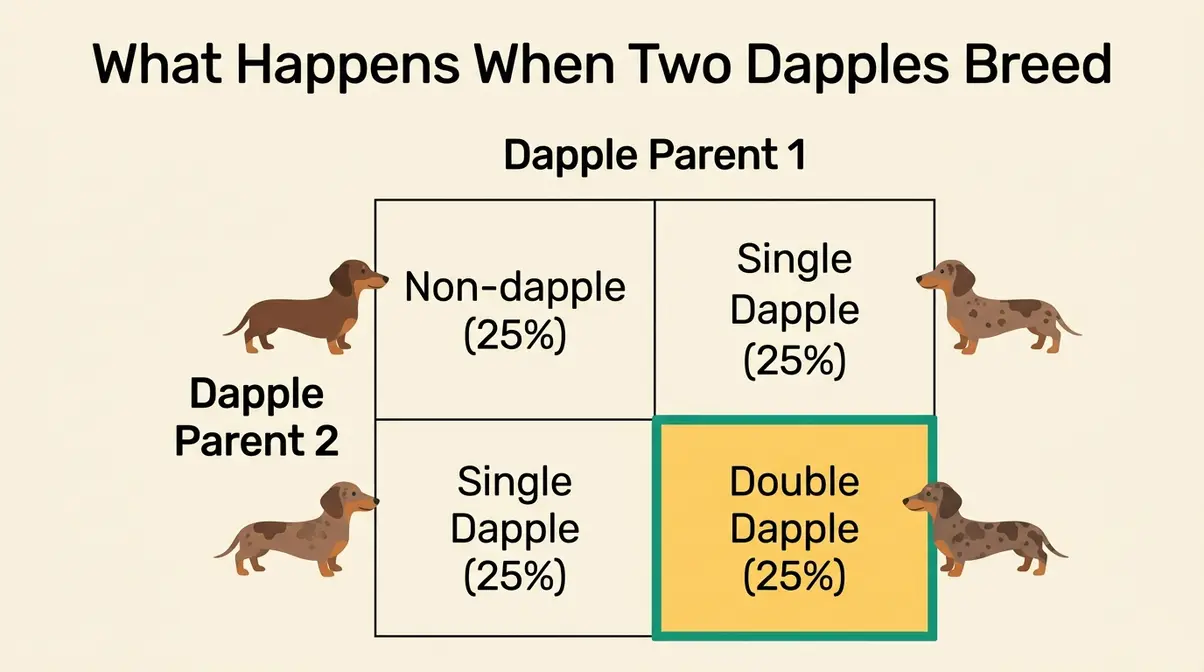
How Double Dapples Are Produced, The PMEL Gene Explained
The PMEL gene is a dominant gene: one copy produces a single dapple with visible (or sometimes invisible) dappling; two copies produce a double dapple. Think of it like a coin flip for each puppy, if both parents carry the dapple gene, roughly one in four puppies may inherit two copies.
The critical complication is cryptic merle. A 2021 study found that genetic testing for the PMEL gene reveals cryptic, hidden, and mosaic PMEL variants that demonstrate the need for genetic testing prior to breeding (National Library of Medicine, 2021). A cryptic merle carrier shows no visible dappling, the coat looks solid or minimally patterned, but the gene is still present and still heritable. This is why accidental litters happen even when owners insist neither parent “looked dapple.”
The infographic above maps all four Punnett square outcomes visually. As the brief explanation goes: “This is why a breeder who says ‘I didn’t know both parents were dapple’ is not necessarily lying, cryptic variants are invisible to the naked eye.”
The Double Dapple Risk Ladder maps directly to these four outcomes: non-dapple puppies sit at the bottom (no elevated risk), single dapples occupy the next rung, and double dapples occupy the top rungs, with the severity of health impact varying within that group.
The science is clear, but what do the organizations that govern dog breeding actually say about this practice?
What Kennel Clubs Say About Double Dapple Breeding
The major breed organizations align on this issue. Here’s a summary of their positions:
| Organization | Position | Source |
|---|---|---|
| Dachshund Club of America | Documents deafness, reduced eye size, and missing eyes as health risks; notes that most breeders only breed dapples to black & tan or chocolate & tan to avoid an accidental double dapple | DCA Colors & Patterns (2020) |
| Dachshund Breed Council (UK) | Calls mating two dapples together irresponsible and unacceptable; states single dapples do not have the double dapple health problems | Dach-Facts: Double Dapple Health Risks |
| American Kennel Club | Defines the dapple (merle) pattern in the official AKC breed standard as lighter-colored areas contrasting with the darker base color; does not endorse double dapple breeding | AKC Breed Standard |
| Royal Kennel Club | States dogs with two copies of the merle gene variant carry increased risk of eye and ear problems; does not register puppies from merle-to-merle matings | Royal Kennel Club (Merle guidance) |
The consensus is clear: responsible, ethical breeders will never purposely breed two dapple dogs together. This isn’t a fringe position, it’s the standard across every major kennel club and breed organization. You can also explore the history of dachshund breeding for broader context on how breed standards developed.
Given this consensus, the answer to whether you should breed a double dapple is clear, but what about dogs that already exist?
Can You Breed a Double Dapple Dachshund?
Can you breed a double dapple Dachshund? Technically yes, but ethically, no. A double dapple can physically reproduce, but here’s the critical point: every puppy born to a double dapple parent will inherit at least one copy of the PMEL gene. Breed a double dapple to a non-dapple, and every puppy will be a single dapple: the UC Davis Veterinary Genetics Laboratory notes that double merle dogs will transmit a merle variant to all of their offspring. Breed a double dapple to another dapple, and the double dapple risk in the litter climbs further.
The responsible path is clear: genetic testing before any Dachshund breeding is the standard recommended by both the UC Davis VGL and the 2021 National Library of Medicine study. You can find guidance on unethical breeding of two dapple Dachshunds on our dapple Dachshund page. If you already have a double dapple, the ethical choice is to spay or neuter and focus entirely on their quality of life.
Now that you understand the genetics, let’s look at how double dapple Dachshunds actually appear, because the variety of colors and coat types surprises many first-time owners.
Double Dapple Dachshund Colors, Coats, and Sizes
Double dapple Dachshunds come in every base color the breed produces: black, chocolate, red, cream, and the dilutes blue and Isabella. What they share is the characteristic white patching overlaid on that base, but the specific color underneath creates dramatically different appearances. The dapple pattern in Dachshunds can appear across all recognized base colors, including black, chocolate, and red, with the double dapple’s characteristic white patches overlaid on any of these bases (the Dachshund Breed Council notes the dapple gene can affect any base colour). Critically, the Double Dapple Risk Ladder applies equally across all color variants: the base color does not change the genetic health risk profile.
| Base Color | Appearance | Common Coat Type | Health Risk |
|---|---|---|---|
| Black | Black base with white patches; may have tan points | Smooth, long, or wire | Same as all double dapples |
| Chocolate | Brown base with white patches; often lighter eyes | Smooth or long | Same as all double dapples |
| Silver | Usually a black and tan dapple with a silvery-grey look; white patches | Smooth or long | Same as all double dapples |
| Blue | Diluted black base with white patches; rare | Smooth | Same as all double dapples; also CDA risk |
| Red/Cream | Warm red or cream base with white patches | Long or smooth | Same as all double dapples |
For a deeper reference on all Dachshund color options, our comprehensive guide to dachshund colors and patterns covers every recognized variation.
Black Dapple Dachshund
A black dapple Dachshund has a black (or black and tan, or black and cream) base with the characteristic white patching of the dapple pattern. In a double dapple, that white patching is large and irregular, the contrast between the dark base and the bright white patches is particularly striking, making black double dapples visually dramatic. Note that “black dapple” can refer to either a single or double dapple, so the term alone doesn’t confirm double dapple status.
All three coat types, smooth, long-haired, and wire-haired, exist in black dapples. The long-haired black dapple is especially popular, with silky feathering that softens the visual contrast. Health-wise, the black base color has no bearing on genetic risk: a black double dapple carries the same eye and ear risks as a chocolate or silver double dapple.
Gray and grey dapple Dachshunds, the same color, two spellings, offer a softer, more muted version of the pattern.
Gray and Grey Dapple Dachshund
Gray and grey are the same color, American versus British spelling. Clarifying this upfront captures both keyword variants and prevents reader confusion. A gray dapple Dachshund has a diluted base coat, typically diluted black or diluted chocolate, with the white patching of the dapple pattern overlaid. In a double dapple, that patching is large and irregular; the overall effect is a soft, muted coat that many owners find particularly beautiful.
The relationship between gray, grey, and silver can be confusing. Generally, “grey” refers to a diluted black base, while “silver” is usually a misnomer: the Dachshund Club of America notes that a black and tan dapple is often mistakenly called a “silver” dapple, and the Dachshund Breed Council says the technically correct name uses the whole base colour, such as black and tan dapple. Both carry the same health risk profile when combined with the double dapple gene pattern.
Silver dapple Dachshunds are a closely related variation, and one of the most visually distinctive.
Silver Dapple Dachshund
A silver dapple Dachshund is usually a black and tan dapple (Dachshund Club of America), and the result is a pale, silvery-grey coat with white patches in a double dapple. The pale, cool tones make silver double dapples stand out even within an already varied breed.
Silver dapples are less common than black or chocolate dapples. That rarity sometimes leads to inflated prices from unethical breeders, which is a warning sign, not a value signal (more on this in the cost section). Because “silver” usually describes the dapple pattern on a black and tan base rather than a dilute coat, the main health consideration for a silver double dapple is the double dapple eye and ear risk, which applies fully. Only a genuinely dilute dog (blue or Isabella) is at risk of Color Dilution Alopecia (CDA), a skin condition affecting dogs with diluted coat colors, causing hair thinning and skin irritation. For more on diluted color health considerations, see our piece on blue dachshund color variation.
Coat type adds another layer of variation, and the long-haired double dapple is one of the most searched-for combinations.
Long-Haired and Miniature Double Dapple Dachshunds
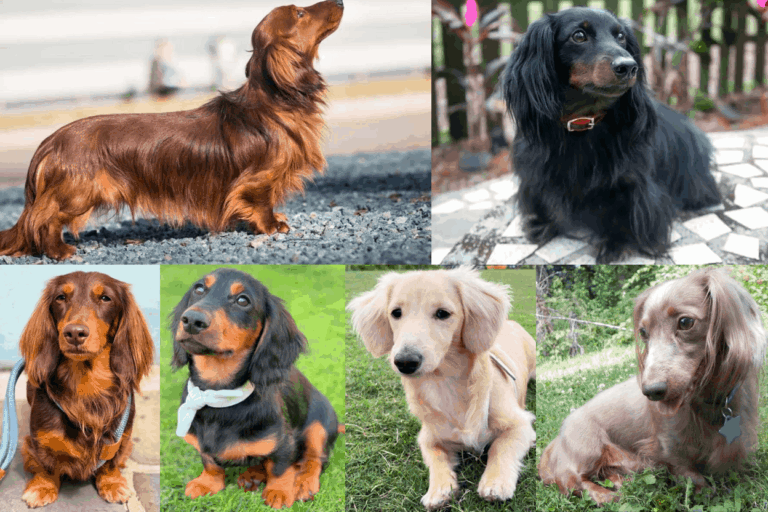
A double dapple mini dachshund, the miniature size variant, is one of the most searched combinations, but carries identical genetic health risks to the standard size. The long-haired double dapple Dachshund is one of the most visually striking combinations the breed offers. The silky, feathered coat of the long-haired variety makes the white patches appear softer and more blended into the base color, less “patchwork” and more “painterly.” The same health risks apply regardless of coat type; the long hair changes only appearance, not genetics.
Smooth-coated and wire-haired double dapples also exist across all base colors. Wire-haired double dapples are less common but share the same genetic profile.
The miniature double dapple Dachshund is not a separate breed or a separate health category, “miniature” refers to size only. Per the AKC standard, miniature Dachshunds weigh 11 lbs and under at 12 months of age. A miniature dachshund double dapple carries identical genetic health risks to a standard double dapple; the smaller size does not reduce or increase the probability of eye or ear defects. If you’re searching for “miniature long-haired dapple Dachshund puppies for sale” or “double dapple mini Dachshund,” apply the same health-risk scrutiny you’d apply to any double dapple, the size is irrelevant to the genetics.
One of the most visually striking, and most misunderstood, double dapple variations is the blue double dapple.
Blue Double Dapple Dachshund
A blue double dapple Dachshund has a diluted black (steel-grey to blue-grey) base with the large, irregular white patches of the double dapple pattern. The combination is rare and visually arresting, which is precisely why unethical breeders market them as “rare” and price them accordingly.
The health picture here is layered. Blue Dachshunds already carry a risk of Color Dilution Alopecia (CDA) from the dilution gene, causing hair thinning and skin problems; VCA Animal Hospitals describes CDA as a recessive, inherited condition most commonly seen in dogs with a blue or fawn coat. A blue double dapple carries both CDA risk and the full spectrum of double dapple eye and ear risks. That’s two separate genetic vulnerabilities in one dog. For a comprehensive look at the blue Dachshund color specifically, our blue dachshund color variation page goes deeper into what you need to know about diluted coat genetics.
When a breeder advertises a blue double dapple as “rare” and charges a premium, that framing should function as a red flag, not a selling point.
Now that you can picture the range of double dapple appearances, let’s clarify how they differ from two patterns they’re often confused with: single dapple and piebald.
Double Dapple vs. Single Dapple vs. Piebald, What’s the Difference?
If you’ve seen a Dachshund with large white patches, how do you know whether it’s a double dapple, a single dapple, or a piebald? The short answer is genetics, but there are visual clues that can help, and the health implications are very different for each. The piebald pattern in Dachshunds is caused by the MITF gene, a completely different gene from the PMEL gene that causes the dapple pattern; Elinor Karlsson and colleagues at the Broad Institute identified the piebald gene in the dog as the pigmentation gene MITF (Louisiana State University deafness program). Piebald Dachshunds do not carry the eye defects of double dapples, but white spotting genes, piebald included, are linked to pigment-associated deafness in dogs (Strain et al., 2009).
This distinction matters enormously for buyers who see white patches and assume the worst. Per the official AKC breed standard, the dapple (merle) pattern is defined as lighter-colored areas contrasting with the darker base color, a definition that covers single dapples, not double dapples as a recognized category.
| Pattern | Gene | Visual Markers | Health Risk |
|---|---|---|---|
| Single Dapple | 1 copy PMEL | Mottled lighter patches on base color; may have 1 blue eye | Low, similar to non-dapple Dachshunds |
| Double Dapple | 2 copies PMEL | Large irregular white patches; often 2 blue eyes or wall eyes | High, elevated risk of blindness, deafness, eye defects |
| Piebald | MITF gene | Symmetrical white patches; clear edges; no blue eyes from this gene | Low for eyes; white spotting is linked to pigment-associated deafness in dogs |
| Dapple Piebald | PMEL + MITF | Combination of dapple mottling AND piebald white patches | Moderate, depends on single vs. double dapple copy |
Dapple vs. Double Dapple, The Key Genetic Difference
The distinction between dapple vs. double dapple Dachshund comes down to one gene copy. A single dapple has one copy of the PMEL gene and typically shows mottled lighter patches on a darker base, like someone has lightly brushed a lighter color over the coat in irregular streaks. A double dapple has two copies and shows the large, irregular white patches described throughout this guide. For a fuller explanation of how the dapple pattern differs from double dapple, our dedicated dapple Dachshund page covers the distinction in depth.
Single dapples are generally healthy. One copy of the PMEL gene does not carry the same elevated eye and ear risks, responsible breeders produce single dapples regularly, and the pattern is recognized and accepted by the AKC. This is an important distinction: seeing dapple markings on a dog does not mean you’re looking at a double dapple.
The visual overlap creates genuine confusion. Some single dapples have one blue eye; some double dapples have minimal white and look almost like single dapples. This is why genetic testing is more reliable than visual identification alone, and why the PMEL gene test is the gold standard, not a photograph.
The piebald pattern is even more commonly confused with double dapple, but the two are genetically unrelated.
Piebald vs. Double Dapple, Spotting the Difference
A piebald Dachshund’s white patches come from the MITF gene, a completely separate gene that controls white spotting in many dog breeds. The MITF gene produces symmetrical white patches with clear, defined edges. Compare that to the irregular, unpredictable white of a double dapple, and the difference becomes clearer in person.
The health implications are critically different. A piebald Dachshund does not carry the elevated eye risks of a double dapple. Hearing is less clear-cut: deafness in dogs is frequently associated with both the piebald and merle genes (Strain et al., 2009), so a BAER hearing test is worth asking about for any heavily white puppy. If you see a white-patched Dachshund and worry it’s a double dapple, check the patch edges: clean and symmetrical suggests piebald; irregular and overlapping suggests dapple.
The dapple piebald combination adds a further layer. A dog can carry both the PMEL (dapple) and MITF (piebald) genes simultaneously, this produces a piebald dapple Dachshund with both patterns visible. If that dog carries only one copy of PMEL, it’s a single dapple piebald with moderate health considerations. If it carries two copies of PMEL, it is a double dapple piebald Dachshund and carries the full double dapple health risks plus the piebald pattern. A dapple piebald is not the same as a double dapple unless it carries two PMEL copies, this distinction is often missing from online discussions, and getting it right matters for health assessment. You can explore dachshund colors and patterns for a broader visual reference.
Now that you can identify a double dapple and understand its risks, the practical question is: where do you find one, and how do you do it ethically?
Finding a Double Dapple Dachshund, Breeders, Rescue, and Adoption
The vast majority of double dapple Dachshunds in rescue organizations are there because of accidental litters or because owners were unprepared for the care demands of a dog with vision or hearing loss. That reality frames the most important recommendation in this guide: rescue first. Rocky Mountain Dachshund Rescue provides specialist support for dogs with vision and hearing impairments, and organizations like theirs are equipped to match double dapples with owners who understand what they’re taking on.
Responsible, ethical breeders will never purposely breed two dapple dogs together, any breeder advertising double dapple puppies as a feature is a red flag, not a selling point (Dachshund Breed Council).
For guidance on finding a reputable dapple dachshund breeder, our dapple Dachshund page outlines what ethical breeding looks like in practice.
Red Flags of an Irresponsible Double Dapple Dachshund Breeder
When you’re evaluating double dapple Dachshund breeders, these six warning signs should make you walk away:
- Advertises double dapple puppies as “rare” or charges a premium for the pattern, ethical breeders do not intentionally produce double dapples; a premium price for “rarity” is a marker of irresponsible breeding.
- Cannot provide genetic test results for both parents, a PMEL gene test from a veterinary genetics laboratory should be available for both parent dogs; no results means no accountability.
- Does not offer a BAER hearing test result for the puppy, the Brainstem Auditory Evoked Response test is the standard diagnostic for deafness; skipping it means the breeder hasn’t checked.
- Has not had the puppy’s eyes examined by a veterinary ophthalmologist, ocular defects may not be obvious on visual inspection; a specialist exam is the responsible standard.
- Claims AKC registration as a quality signal for a double dapple, the official AKC breed standard defines the dapple pattern but does not endorse double dapple breeding; a breeder using AKC registration to imply the double dapple pattern is officially sanctioned may be misrepresenting what registration actually means (American Kennel Club).
- Discourages questions or a veterinary check before purchase, a responsible breeder welcomes scrutiny; resistance to questions is a significant warning sign.
What does a responsible breeder look like? They’ll proactively disclose health risks, provide documentation, and may actually discourage you from buying if they believe you’re unprepared for a dog with sensory impairments. Some double dapples do come from genuinely accidental litters, breeders who didn’t know both parents carried the dapple gene. That doesn’t make the puppy less at risk, but it changes the ethical calculus: the breeder may be willing to work transparently with you rather than hiding the situation.
If you’ve already decided you want a double dapple, rescue is the most ethical path, and there are organizations specifically equipped to help.
Rescuing a Double Dapple Dachshund
Rescue is the recommended path for anyone drawn to a double dapple Dachshund. Dogs in breed-specific rescues often come with known health histories, they’ve been assessed by veterinarians, their hearing and vision status is documented, and the rescue staff understand what the dog needs. That transparency is genuinely valuable when you’re committing to a dog with potential sensory impairments.
Dachshund-specific rescues are the best starting points for your search. The Dachshund Club of America maintains a rescue network you can access through their official website, and Rocky Mountain Dachshund Rescue is one of the most experienced organizations for dogs with vision and hearing impairments. Searching “dachshund rescue” plus your state or region will surface additional breed-specific organizations in your area.
The adoption process for a double dapple typically includes health disclosure from the rescue, a home assessment, and often a foster-to-adopt option that lets you understand the dog’s specific needs before committing fully. A pre-adoption veterinary consultation is strongly advisable, bring the rescue’s health records and request a BAER test if one hasn’t been performed.
Before you commit to any double dapple, rescued or otherwise, it’s worth understanding what you’re likely to pay, and why price can be a warning sign.
How Much Does a Double Dapple Dachshund Cost?
A dapple Dachshund from a reputable breeder is priced based on health testing, lineage, and veterinary care, not coat pattern. Typical Dachshund prices from responsible breeders vary by region, lineage, and coat type, and what matters most is not the asking price but what health testing and documentation it covers. What’s consistent is this: ethical breeders do not intentionally produce double dapples, so a breeder advertising them as “rare” and charging a premium is a red flag, not a quality signal. If you encounter a double dapple, rescue is both the most ethical option and often the more affordable one, adoption fees from breed-specific rescues are typically a fraction of breeder prices.
Why a Low, or High, Price Is a Red Flag
Both ends of the price spectrum warrant caution with double dapple Dachshunds. A very low price, “free to good home” or unusually cheap for a puppy, may indicate an accidental litter where the breeder wants to offload quickly. The dog may have undisclosed health issues, and the breeder may not have invested in any health testing.
A very high price marketed as a “rare double dapple” is the opposite problem. Here, the breeder is intentionally producing dogs with known health risks and charging a premium for the pattern itself. That pricing model depends on buyers not knowing what double dapple genetics mean, which is precisely why reading a guide like this one matters.
What does legitimate pricing look like? A reputable breeder charges for health testing, genetic screening, veterinary care, and the quality of the breeding program, not for the “rarity” of a coat pattern. When you’re comparing double dapple Dachshund prices, the presence of PMEL gene test results and BAER test documentation is a far better value signal than the asking price itself.
Beyond the purchase decision, life with a double dapple Dachshund raises practical questions about daily care, and the breed’s general temperament.
General Dachshund Care and Behavior
Dachshunds are loyal, curious, and famously stubborn, a combination that makes them endlessly entertaining and occasionally maddening. They bond closely, they love to burrow, and they tend to have strong opinions about most things. For a double dapple Dachshund, all of that applies, with some specific adaptations needed for dogs managing hearing or vision loss.
Temperament and Daily Life with a Double Dapple Dachshund
Dachshunds are affectionate, pack-oriented dogs that thrive on human company. They often bond closely with one person while remaining sociable with the whole family. Males are often described as more openly affectionate and attention-seeking; females as more independent and occasionally more stubborn. Neither is universally “easier”, individual personality and early socialization matter far more than sex.
For a deaf double dapple, verbal commands simply don’t land. Hand signals work well as replacements, a flat palm for “stay,” a beckoning gesture for “come,” a pointed finger for “sit.” Vibration cues (a gentle tap on the floor near the dog) can get their attention safely. A partially blind Dachshund benefits enormously from a consistent home layout: avoid rearranging furniture, keep feeding and sleeping spots in the same location, and use scent markers near hazards like stairs. Consistency is your most powerful training tool with a sensory-impaired dog, and most double dapples adapt remarkably well once their environment is predictable.
Dachshunds are not well-suited to extended time alone. Two to four hours is a more comfortable maximum for the breed, they’re social dogs prone to separation anxiety, and leaving one alone for 8 hours is generally not recommended. For a double dapple with sensory impairments, extended alone time can be especially stressful: they rely more heavily on familiar sensory cues and human presence for security. Consider a dog walker, a doggy daycare arrangement, or a canine companion if your schedule demands long absences.
These day-to-day questions come up constantly in Dachshund communities, here are the most common ones, answered directly.
Frequently Asked Questions
Can a double dapple be healthy?
Some double dapple dachshunds live full, healthy lives, but the genetic risk is significant. Because they carry two copies of the merle gene, they have an elevated probability of congenital eye defects (including reduced or absent eyes) and hearing loss. Some are only mildly affected; others are profoundly disabled. The outcome cannot be predicted by appearance alone, which is why genetic testing and a full veterinary assessment, including a BAER hearing test and ophthalmological examination, are essential before committing.
How can you tell if a dachshund is a double dapple?
Look for three key signs: large, irregular white patches on the body (especially the neck, chest, paws, and tail tip); one or both blue eyes or a “wall eye” (one blue, one brown); and a lighter-than-expected base coat. Visual identification isn’t definitive, some double dapples have minimal white. A PMEL gene test from a veterinary genetics laboratory is the only reliable confirmation, and it’s the standard recommended by the UC Davis Veterinary Genetics Laboratory.
What is the life expectancy of a double dapple dachshund?
There is no documented evidence that double dapple dachshunds have a shorter lifespan than the breed average of 12-16 years (American Kennel Club breed profile). However, the congenital health issues they’re prone to, vision loss, deafness, and potential spinal problems, can significantly affect quality of life and require lifelong veterinary management. With attentive care and early intervention, many double dapples live full, happy lives alongside their families.
How much is a dapple dachshund worth?
A dapple dachshund from a reputable breeder is priced based on health testing, lineage, and care, not coat pattern. Ethical breeders do not intentionally produce double dapples, so a breeder advertising them as “rare” and charging a premium is a red flag for irresponsible breeding. Rescue is the most ethical and often more affordable option; adoption fees from breed-specific rescues are typically a fraction of breeder prices.
What is the main cause of death in dachshunds?
Published, breed-specific data on causes of death in dachshunds are limited. The breed is significantly affected by intervertebral disc disease (IVDD), a spinal condition that can cause paralysis and, in severe cases, may lead to euthanasia. For double dapple dachshunds, managing vision and hearing loss alongside these breed-wide risks can compound the veterinary burden over a lifetime.
Do dachshunds like to sleep with their owners?
Dachshunds are famously fond of burrowing and sleeping close to their people, it’s a deeply ingrained trait rooted in their history as den-dwelling hunting dogs. Most dachshund owners find their dogs seeking out warmth under blankets or pressing against them at night. For double dapple dachshunds with hearing or vision loss, the physical closeness of a familiar person provides more than comfort, it offers a reliable sensory anchor that reduces anxiety.
Are girl or boy dachshunds nicer?
Temperament in dachshunds varies more by individual personality and upbringing than by sex. Males are often described as more openly affectionate; females as more independent and sometimes more stubborn. Neither is universally “nicer”, both make wonderful companions with the right socialization. For a double dapple dachshund, the more relevant factor is whether the dog’s specific sensory impairments have been addressed through appropriate training from an early age.
Can a dachshund be left alone for 8 hours?
Most dachshunds do not cope well with 8 hours alone, they’re social, pack-oriented dogs prone to separation anxiety, and two to four hours is a more comfortable maximum. For a double dapple dachshund with hearing or vision loss, extended alone time is particularly stressful: these dogs rely more heavily on familiar sensory cues and human presence for security. A dog walker, doggy daycare, or canine companion can make a real difference if your schedule demands long absences.
What to Do If You’re Considering a Double Dapple Dachshund
For anyone considering a double dapple dachshund, the genetic risks are real and well-documented, but so is the capacity of these dogs to live full, joyful lives with the right care. The key is going in with clear eyes. A double dapple carries two copies of the PMEL merle gene, which raises the probability of congenital blindness, deafness, and eye deformities. The breed bodies agree: the Dachshund Breed Council calls mating two dapples irresponsible and unacceptable, the Royal Kennel Club will not register puppies from merle-to-merle matings, and the Dachshund Club of America documents the health issues double dapples are more likely to carry. At dachshundtales.com, we believe that consensus deserves to be front and center in every conversation about this dog.
The Double Dapple Risk Ladder is the framework that keeps this decision grounded. Not every double dapple sits at the top of the ladder, outcomes range from mildly affected to profoundly disabled, and where a specific dog sits on that spectrum should calibrate your decision. A dog with unilateral hearing loss and full vision is a very different commitment from one born without eyes. The ladder isn’t about fear; it’s about precision.
Before you commit, request a full veterinary assessment including a BAER hearing test and ophthalmological examination. If you’re open to rescue, contact a dachshund-specific rescue organization and ask specifically about double dapples in their care.
Sources
- Dachshund Magazine On-Line, “The Double Dapple”. www.dachshund.org
- Dachshund Breed Council, “Dach-Facts: Double Dapple Health Risks” (2008). dachshundbreedcouncil.wordpress.com
- Dachshund Breed Council, “Coat and Colour” (2012). dachshundbreedcouncil.files.wordpress.com
- Dachshund Club of America, “Dachshund Colors & Patterns” (2020). www.dachshundclubofamerica.org
- The Royal Kennel Club, “What is merle?”. www.royalkennelclub.com
- UC Davis Veterinary Genetics Laboratory, “Merle” test information. vgl.ucdavis.edu
- Ballif BC et al. “The PMEL gene and merle (dapple) in the dachshund: cryptic, hidden, and mosaic variants demonstrate the need for genetic testing prior to breeding.” Human Genetics, 2021. pubmed.ncbi.nlm.nih.gov
- American Kennel Club, Dachshund breed profile (life expectancy, height and weight). www.akc.org
- American Kennel Club, Official Standard of the Dachshund. images.akc.org
- Strain GM et al. “Prevalence of deafness in dogs heterozygous or homozygous for the merle allele.” Journal of Veterinary Internal Medicine, 2009. pubmed.ncbi.nlm.nih.gov
- Strain GM. “The Genetics of Deafness in Domestic Animals.” Frontiers in Veterinary Science, 2015. pmc.ncbi.nlm.nih.gov
- Louisiana State University School of Veterinary Medicine, “What is the BAER test?”. www.lsu.edu
- Louisiana State University School of Veterinary Medicine, “Deafness in Dogs and Cats”. www.lsu.edu
- VCA Animal Hospitals, “Color Dilution Alopecia in Dogs”. vcahospitals.com
- Packer RMA, Seath IJ, O’Neill DG, De Decker S, Volk HA. “DachsLife 2015: an investigation of lifestyle associations with the risk of intervertebral disc disease in Dachshunds.” Canine Genetics and Epidemiology, 2016. pmc.ncbi.nlm.nih.gov
- Cornell University College of Veterinary Medicine, Riney Canine Health Center, “Intervertebral disc disease”. www.vet.cornell.edu